Edge digital twins must learn the difference between simulation and hardware without discarding the physics that makes a converter understandable. Physics-Embedded Neural ODEs, or PENODE, address that challenge by preserving the known continuous-time dynamics and learning only the missing behavior.
Learning the model residual
Purely physical models are interpretable but cannot always represent parasitics, nonideal switching, temperature drift, and parameter mismatch. Black-box neural networks can fit these effects, yet they often need more data and may generalize poorly outside the training distribution.
PENODE combines both sources of knowledge:
- A physical ODE describes the known converter dynamics.
- A Neural ODE learns the continuous-time residual between simulation and experiment.
- A multi-mode event automaton activates the correct dynamics at each switching event.
- A cloud-to-edge workflow trains the model offline and deploys it for real-time inference.
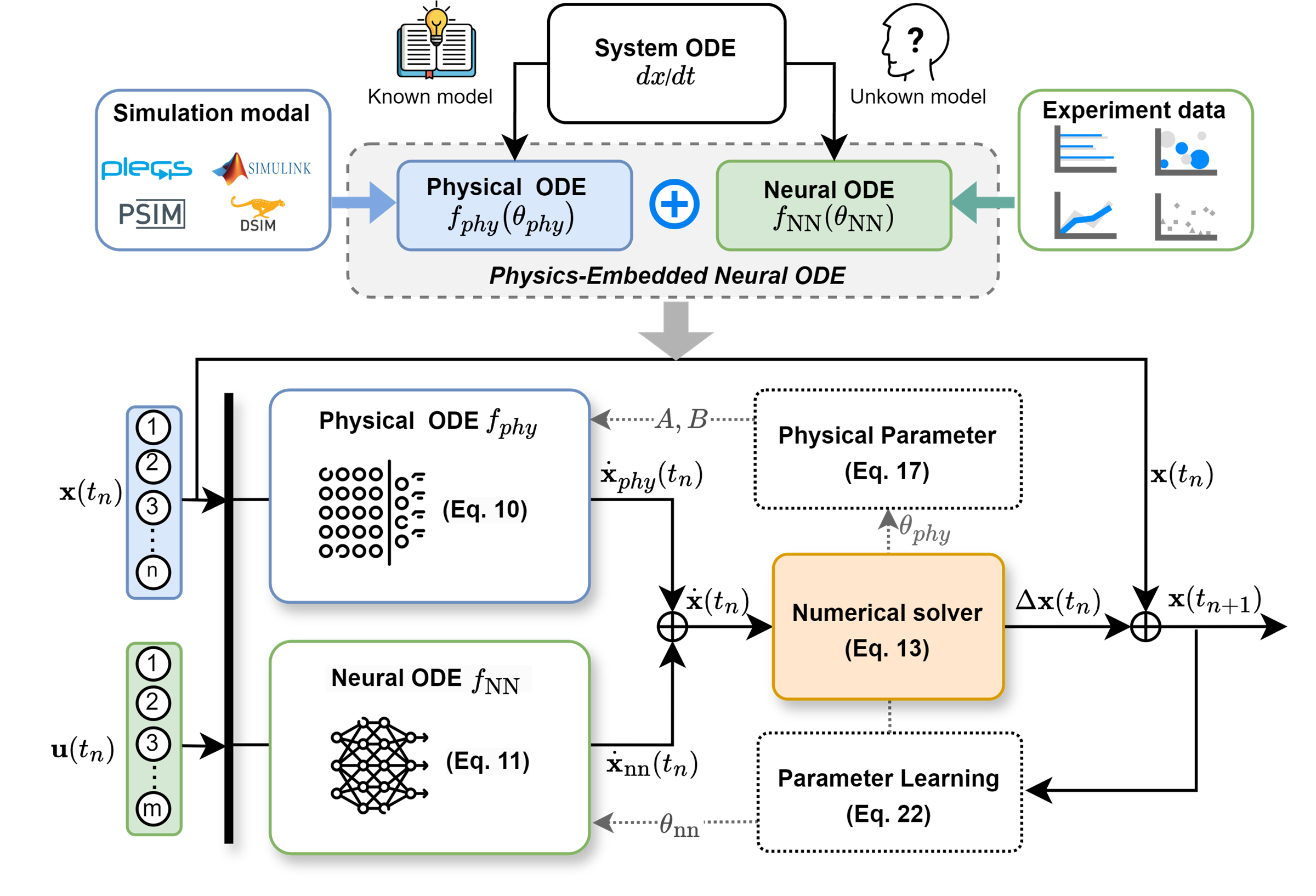
One framework, three knowledge levels
The method was evaluated under white-box, gray-box, and black-box assumptions. The training data covered 1,200 converter trajectories spanning output-voltage references, load profiles, and disturbances, with a 70/20/10 training, validation, and test split.
In the white-box case, PENODE reached an R-squared score of 0.99, compared with 0.95 for the physics-guided recurrent baseline. In the more practical gray-box case, PENODE achieved 0.97, while the recurrent baseline reached 0.9088 and the incomplete physical model reached 0.68. The event-automata structure also reached an equivalent loss roughly 40 epochs earlier and reduced Neural ODE model complexity by more than 75%.
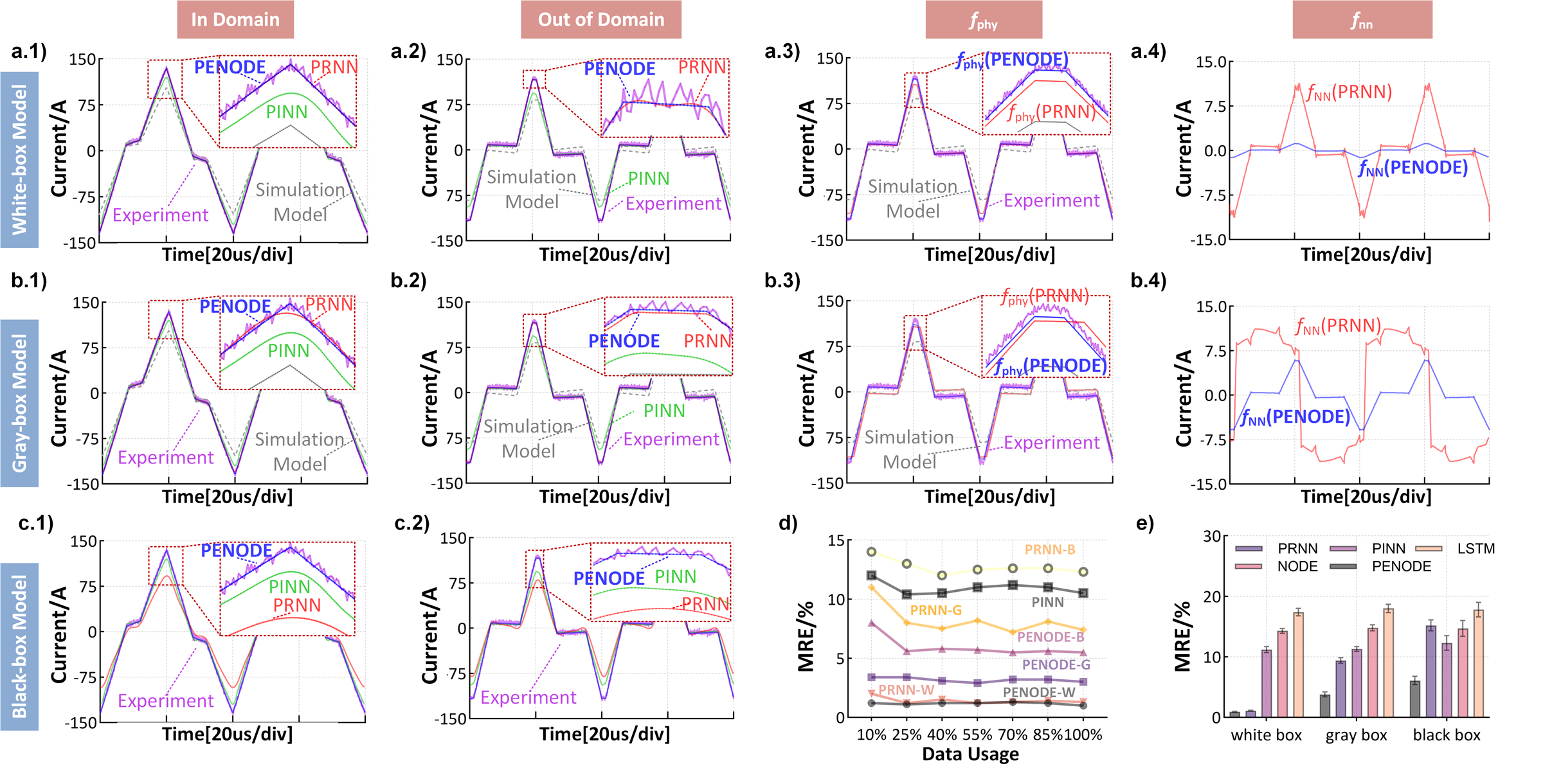
Designed for an edge digital twin
Using the proposed event-driven solver, the FPGA implementation completes one control-cycle inference in 12.6 μs. It uses 19.2% of DSPs, 7.86% of BRAM, and 6.79% of LUTs—substantially less than the PINN and recurrent baselines. Relative to the slowest baseline, inference is 4.7× faster.
The model was then connected to a physical converter. It reproduced switch-level current dynamics under PI control and supplied high-frequency current estimates to MPC. The calibrated Sim-to-Real twin eliminated the overshoot produced by the uncalibrated simulation model and allowed the converter to reach its new operating point in one cycle.
Why continuous-time learning helps
A fixed-step recurrent model learns a transition tied to one sampling interval. Changing that interval or encountering irregular switching events can require retraining. PENODE instead learns a derivative function that a compatible numerical solver can evaluate over different step sizes. The model therefore follows the converter’s event timing while retaining a continuous representation between events.
Embedding the residual inside the ODE also creates a useful division of labor. Known circuit laws explain the dominant energy transfer, while the network focuses on parasitics and discrepancies that are difficult to parameterize. In white-box operation the correction remains small; as physical knowledge is removed, the learned component contributes more without changing the overall architecture.
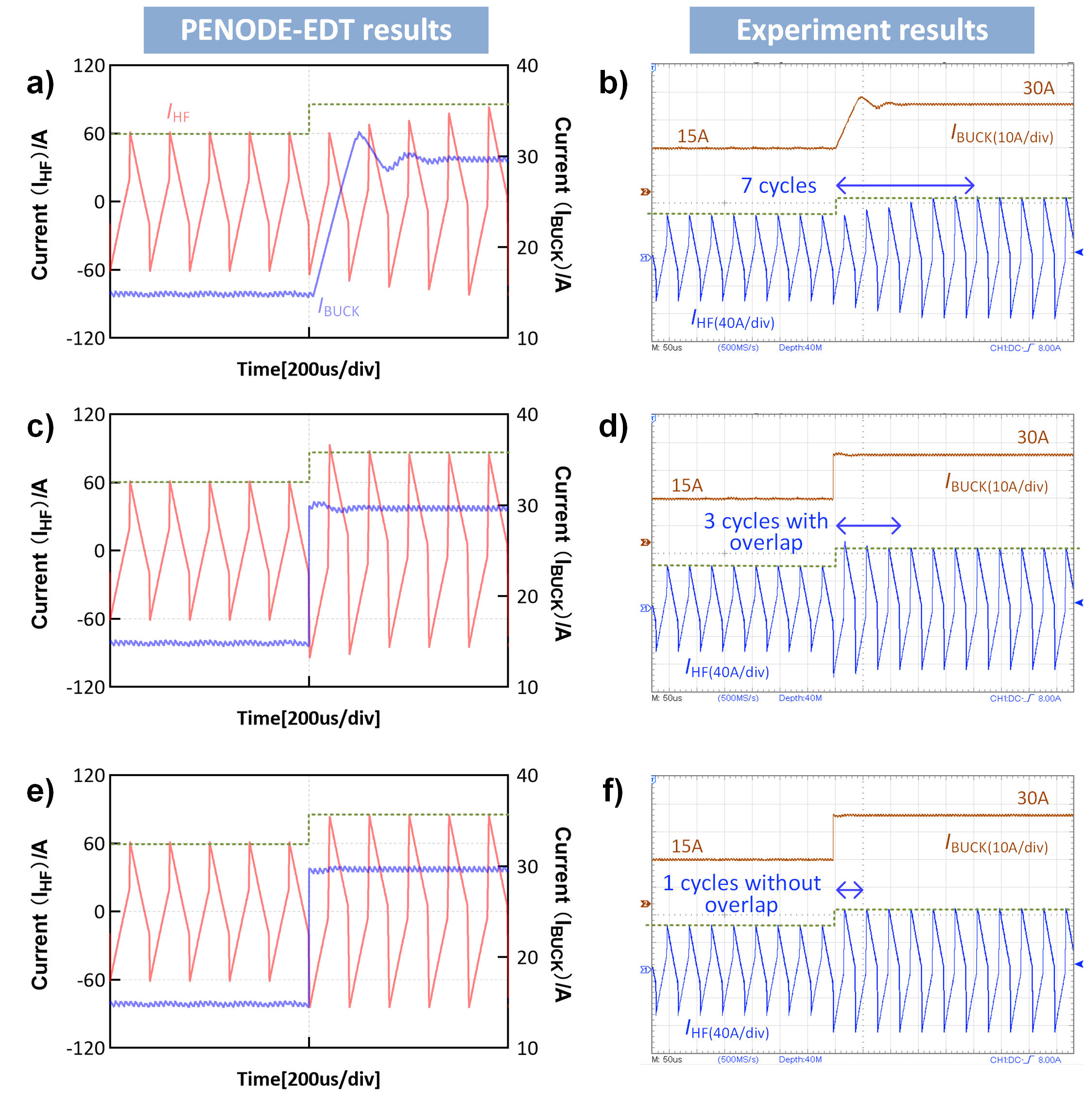
Why it matters
PENODE treats physics as the structure of learning, not merely a penalty term. The result is a compact continuous-time model that can adapt from simulation to hardware and still execute on a resource-constrained edge device.
Published in IEEE Transactions on Industrial Electronics, vol. 73, no. 6, pp. 8616–8627, June 2026.