Real-time digital twins often spend most of their computation not on the physical model itself, but on repeatedly generating mode-dependent matrices and evaluating high-order numerical integration. This work asks whether those bottlenecks can be learned once, then executed efficiently at the edge.
Replacing solver bottlenecks
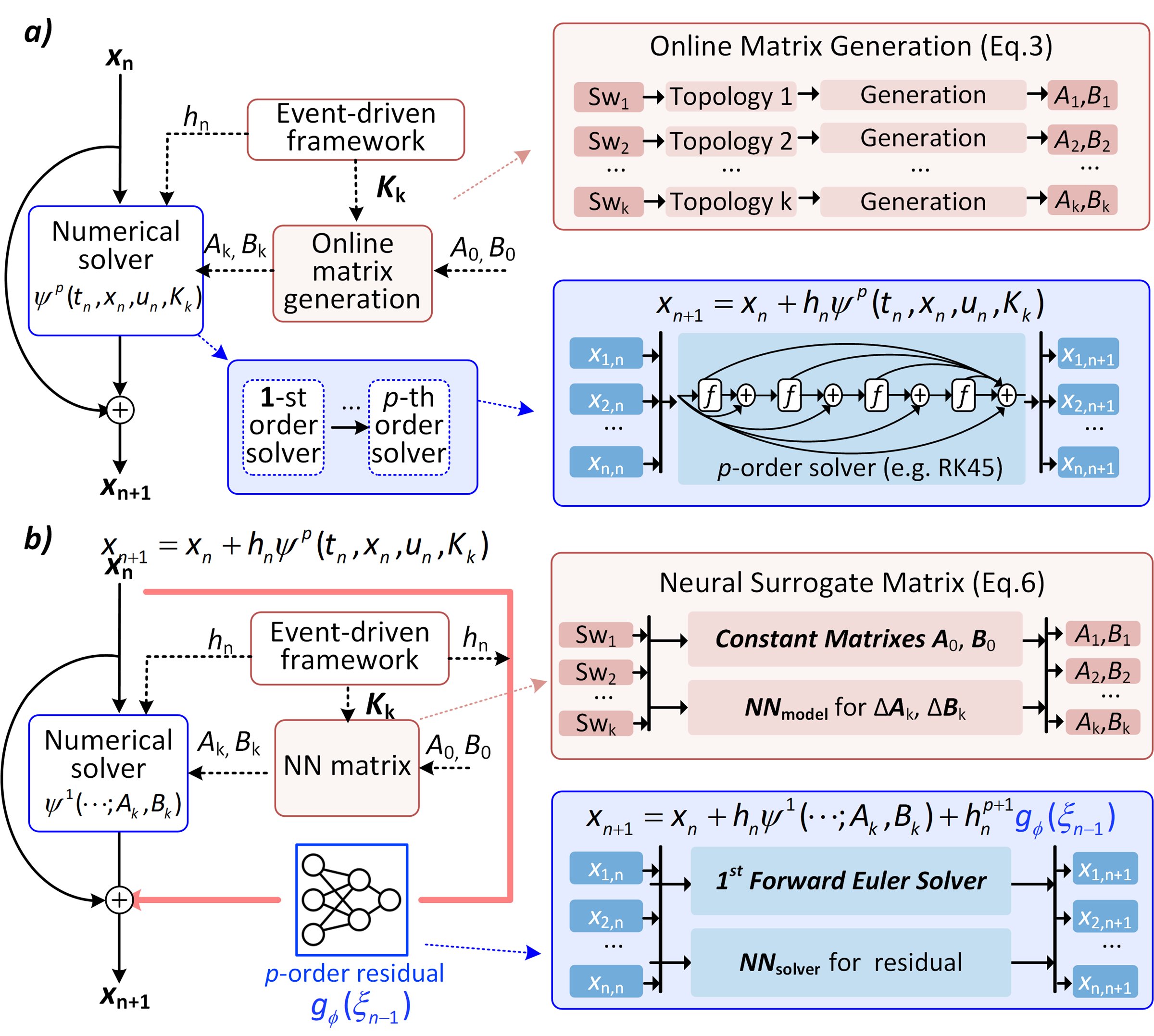
Traditional hybrid-system solvers perform a sequence of matrix construction, derivative evaluation, and high-order integration steps. These operations are accurate, but their sequential nature is difficult to accelerate and produces variable execution time.
The proposed Neural Surrogate Solver (NSS) uses two compact networks:
- NN model maps the converter’s switching state to mode-dependent system matrices.
- NN solver predicts the high-order residual that corrects a lightweight first-order integration step.
The physical state update remains explicit, while the expensive numerical components become single-pass, parallelizable inference operations.
From algorithmic gain to hardware acceleration
The matrix network was trained on all 256 switching-mode mappings. The solver network used 512,000 trajectories generated from a high-accuracy Dormand–Prince reference, with both datasets divided into 70% training, 20% validation, and 10% testing.
On the same CPU, NSS was 3.2× faster than the state-of-the-art event-driven solver. Mapping the parallel neural computation to FPGA provided a further 7.2× hardware acceleration, giving an overall speedup of approximately 23× relative to the CPU event-driven baseline.
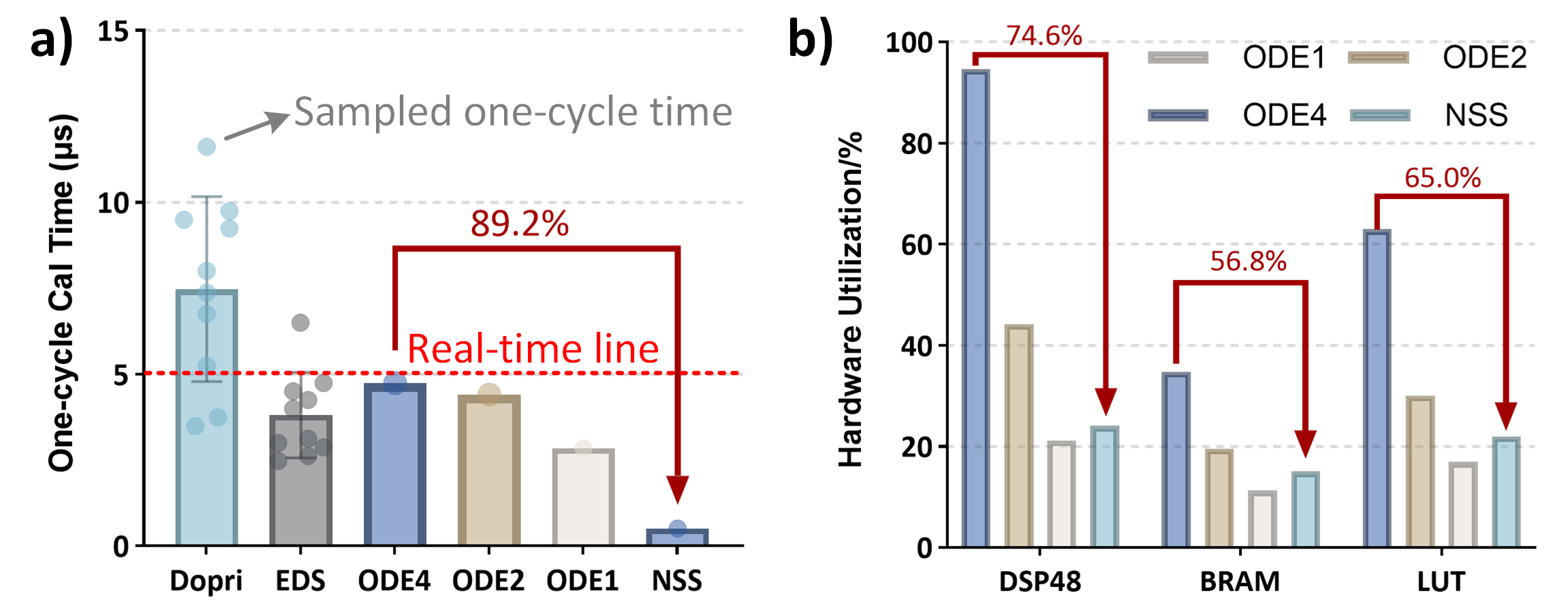
Unlike variable-step solvers, NSS also maintains a predictable execution time. Its one-cycle calculation time is 89.2% lower than the FPGA fourth-order solver and remains safely below the real-time deadline.
More room for control
Compared with the fourth-order FPGA baseline, NSS reduces DSP use by 72.5%, BRAM by 56.8%, and LUTs by 65.0%, corresponding to approximately 60% overall resource savings. That leaves room for state estimation and control logic on the same edge device.
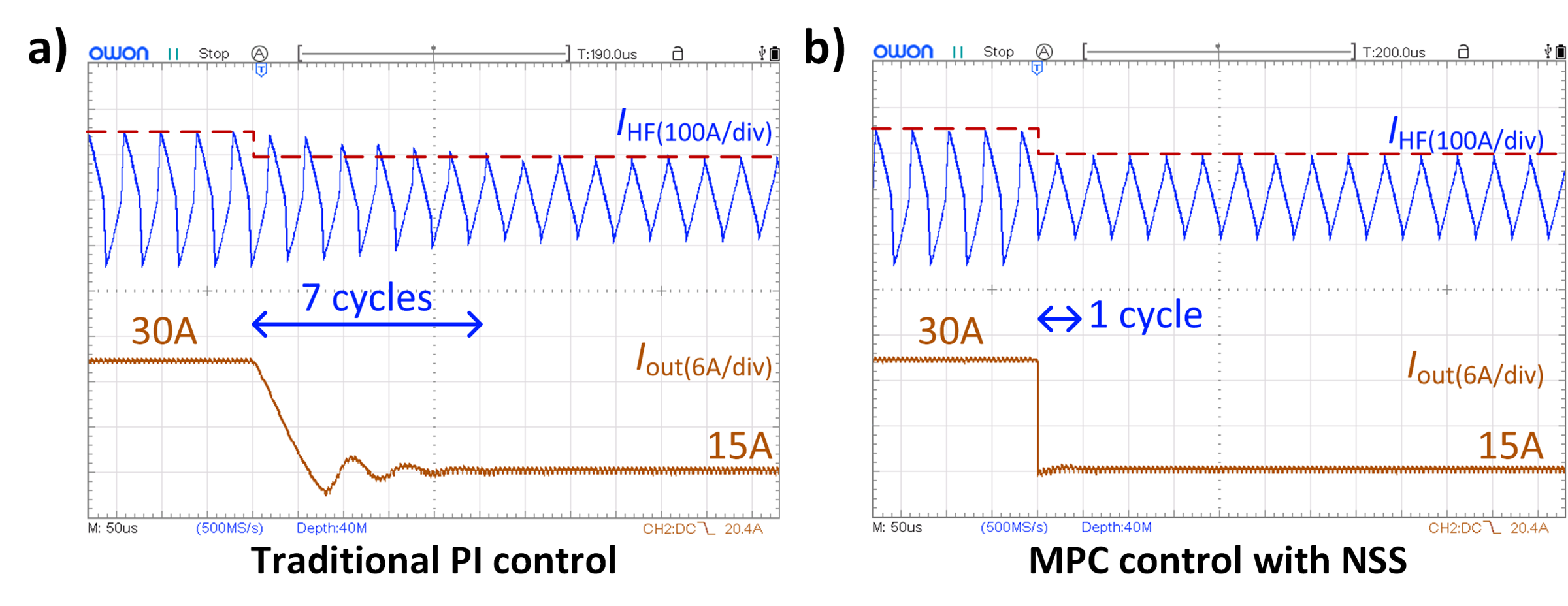
To demonstrate that the acceleration preserves useful dynamics, NSS was integrated into MPC for a dual-active-bridge converter. It supplied high-frequency current estimates in place of bandwidth-intensive sensors. During a load transition, the NSS-based MPC reached its new steady state within one switching cycle, compared with seven cycles under traditional PI control.
Accuracy without unpredictable timing
For embedded control, worst-case execution time matters as much as average speed. Adaptive numerical solvers may take more internal steps when a switching event or fast transient occurs, producing latency precisely when the controller needs a new estimate. NSS uses a fixed neural dataflow at every event, so computation time remains stable and easier to schedule alongside PWM and protection logic.
The surrogate is also narrower than a black-box system model. It learns the expensive numerical operations while the surrounding state-space update and event structure remain explicit. This keeps the method portable: a new topology changes the offline training data and dimensions, but the edge implementation follows the same matrix-surrogate and residual-correction pipeline.
Why it matters
NSS moves numerical effort from online execution to offline learning. It preserves the converter's hybrid structure while converting sequential computation into hardware-friendly parallel inference.
Published in IEEE Transactions on Industrial Electronics, vol. 73, no. 6, pp. 9523–9528, June 2026.