Can a model be as accurate as a neural network while remaining an equation that engineers can read, evaluate, and reason about? This recent research project explores that question for high-frequency magnetic core loss.
The modeling gap
Magnetic core loss increasingly limits the efficiency and thermal performance of high-frequency power converters. The classical Steinmetz Equation is compact and useful, but its fixed structure can miss nonlinear behavior over wide frequency and flux-density ranges. Modern machine-learning models improve accuracy, yet usually return a black box rather than a design equation.
The goal of Learnable Symbolic Sparse Identification (LSSI) is to retain both sides: the accuracy of data-driven learning and the transparency of an explicit analytical model.
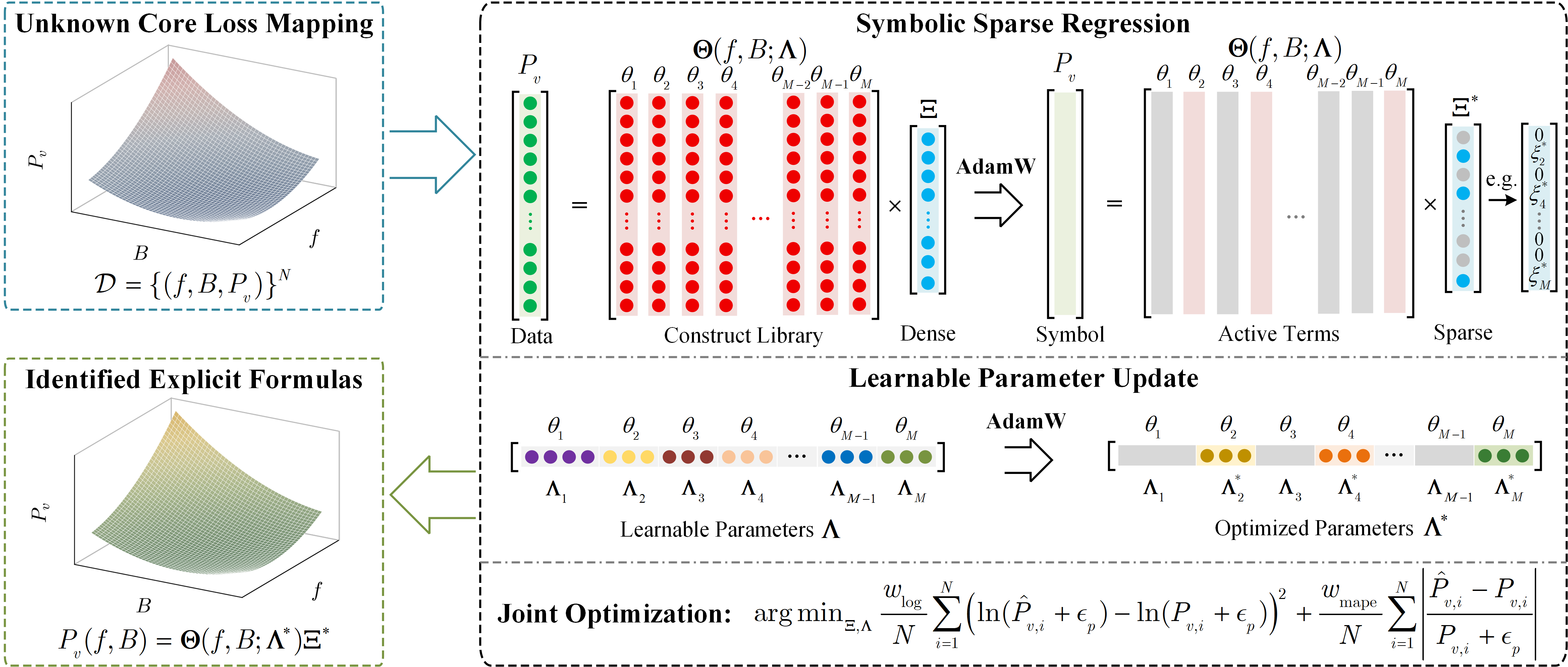
LSSI in three steps
- Build a physics-aware library. Candidate terms represent hysteresis, eddy-current, anomalous, saturation, cross-coupling, and bias effects.
- Learn structure and exponents together. Sparse coefficients select the dominant mechanisms while learnable parameters capture the fractional power laws found in magnetic materials.
- Prune the equation. AdamW-based joint optimization and thresholding remove uninformative terms, leaving a compact, non-negative loss model.
This is the key distinction from conventional symbolic regression: the candidate functions are not restricted to fixed integer exponents. Their internal parameters adapt continuously to the measured data while remaining bounded by physically meaningful ranges.
What the framework discovered
For sinusoidal excitation, the identified normalized loss equation contains only four active contributions: a nonlinear hysteresis term, an eddy-current term, a saturation-sensitive power term, and a small flux-density term.
The resulting expression uses 15 learned parameters, compared with 4,417 parameters in the feedforward neural-network baseline. More importantly, every retained term can be inspected and evaluated without running a black-box inference model.
Experimental validation
The framework was evaluated using more than 1,000 experimental samples from Fair-Rite 95 ferrite cores under sinusoidal excitation at 25 degrees Celsius. The dataset was split into 80% training and 20% test data.
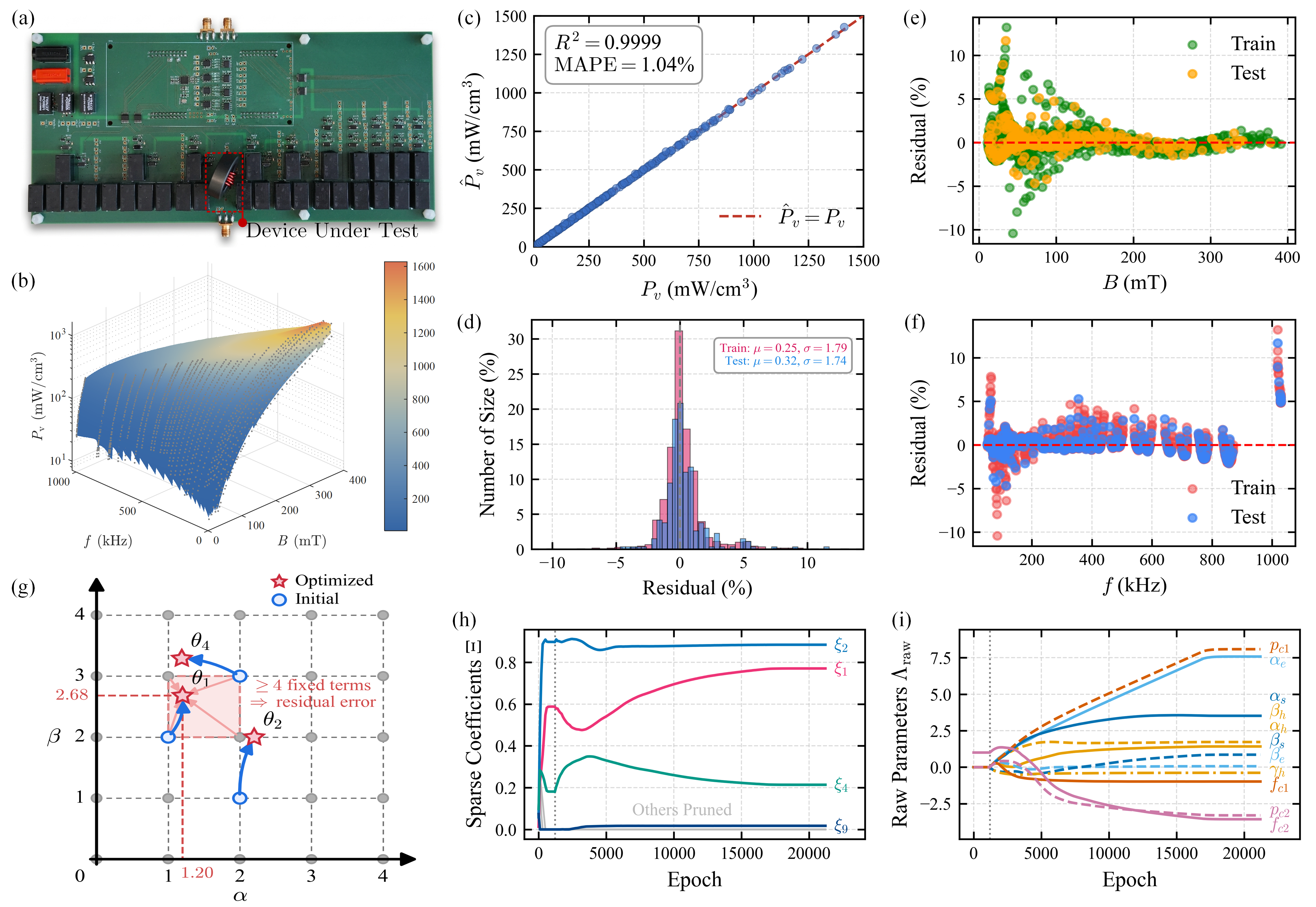
Predicted and measured losses align closely across the operating range. The test residuals remain concentrated around zero, with no strong systematic trend against either flux density or frequency. This indicates that the compact equation preserves the dominant behavior without the complexity of a large statistical model.
| Model | MAPE | R-squared | Parameters | Active terms |
|---|---|---|---|---|
| Steinmetz Equation | 10.92% | 0.9868 | 3 | 1 |
| Random Forest | 5.13% | 0.9961 | 199,555 | - |
| Feedforward NN | 1.37% | 0.9996 | 4,417 | - |
| Fixed-parameter SSI | 1.56% | 0.9997 | 7 / 103 | 7 |
| LSSI | 1.04% | 0.9999 | 15 / 24 | 4 |
Why it matters
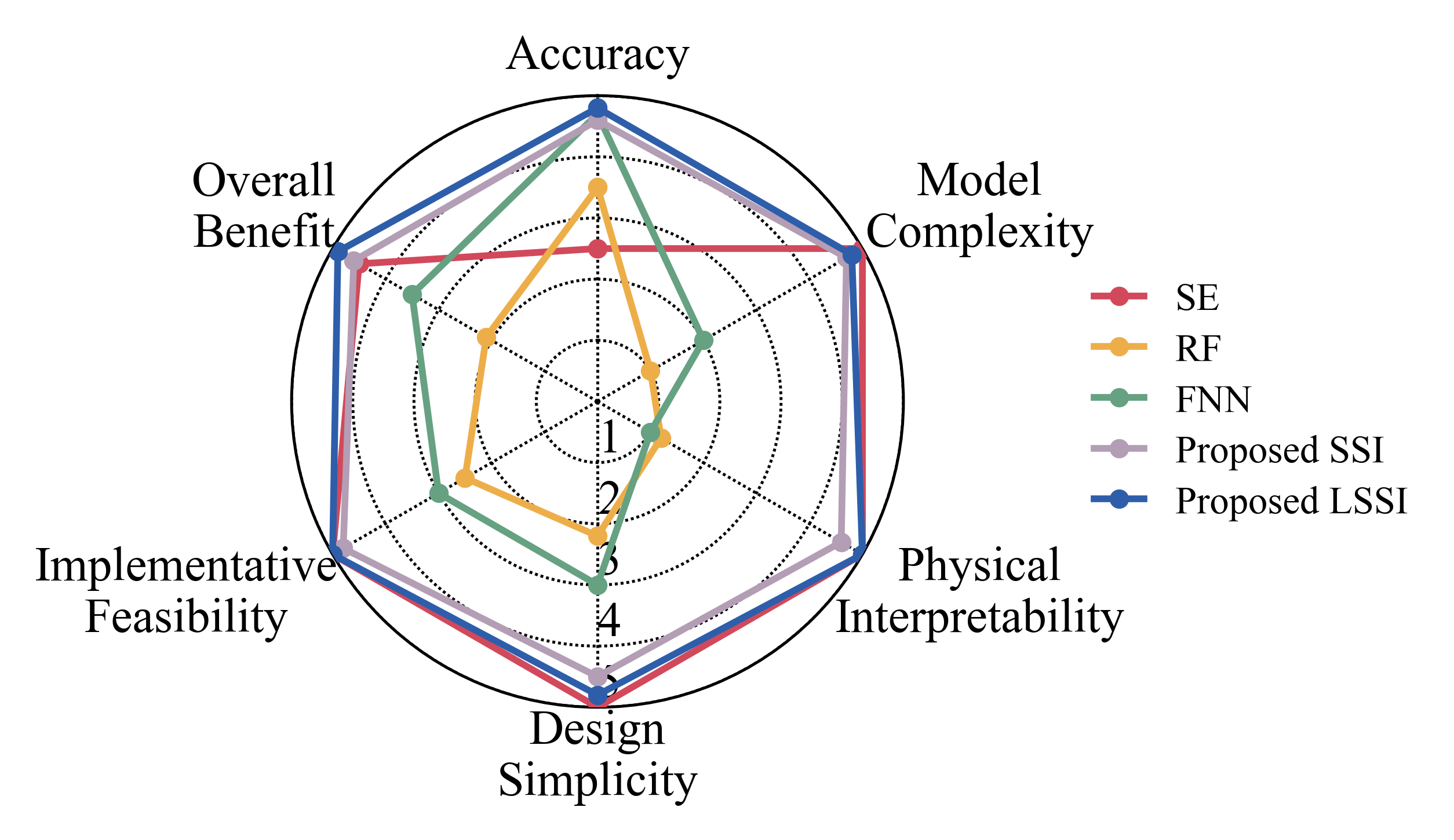
The result is not merely a more accurate fit. It is a design-ready equation: fast to evaluate, compact enough to inspect, and structured around recognizable loss mechanisms.
This makes LSSI promising for magnetic-material characterization and component design where both prediction quality and engineering intuition matter. Future work will extend the framework to temperature-dependent behavior and non-sinusoidal excitation.