A high-frequency power converter changes operating mode every few microseconds. Can its digital twin remain fast and accurate enough to participate directly in the control loop? This work develops a cognitive digital twin that identifies modes and parameters online, reconstructs internal states, and supplies them to model predictive control.
From monitoring to control
Conventional digital twins commonly use fixed models and time-driven solvers. They are useful for monitoring, but their computational cost and sensitivity to parameter drift make safety-critical, closed-loop use difficult.
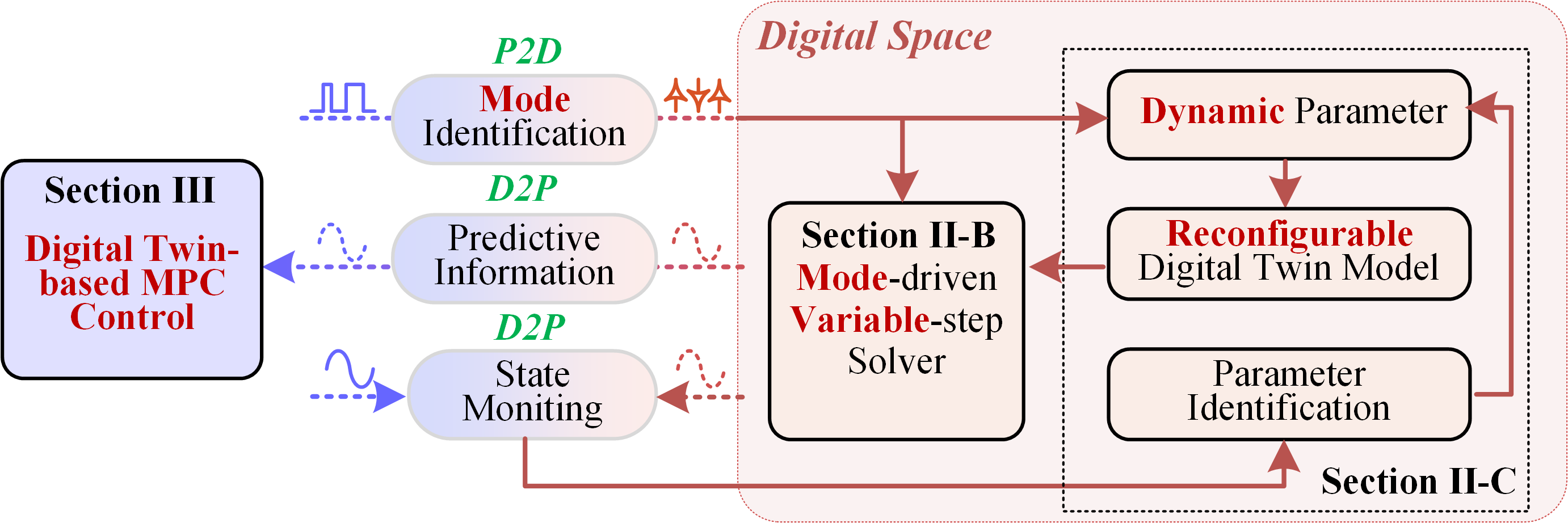
The proposed Cognitive Digital Twin (CDT) changes that architecture in three ways:
- Mode identification follows the converter’s switching events instead of advancing through many uniform time steps.
- Online parameter identification continually reconfigures the model as the physical converter changes.
- Control enhancement provides estimated high-frequency states directly to the MPC, reducing dependence on delayed sensor samples.
Fast, event-driven inference
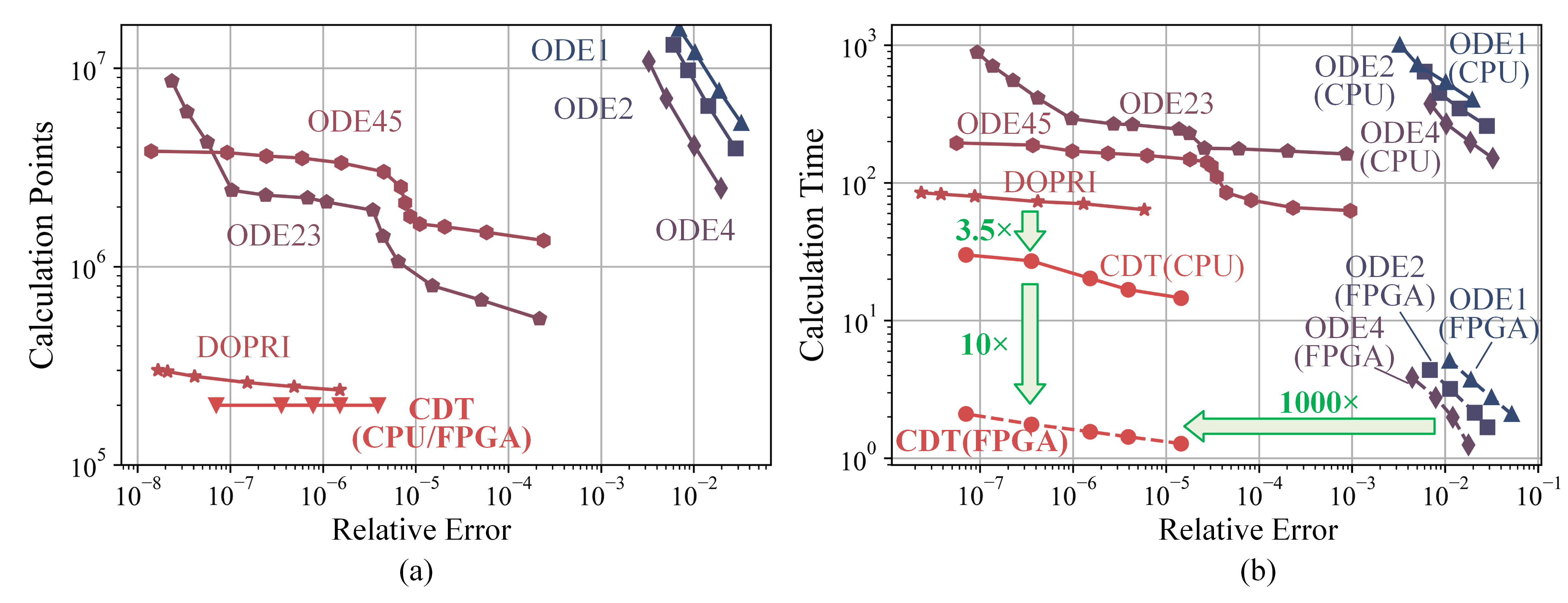
Instead of resolving every switching period with hundreds of fixed steps, the CDT evaluates the system only at meaningful mode transitions. It needs eight calculation points per switching cycle, compared with 800, 400, and 200 points for first-, second-, and fourth-order fixed-step solvers in the tested setting.
On the FPGA implementation, this produces approximately 35× faster inference than state-of-the-art offline simulation while improving estimation accuracy by roughly three orders of magnitude. The implementation occupies 19.2% of DSPs, 6.79% of LUTs, and 3.95% of BRAM on the target platform.
Closing the loop
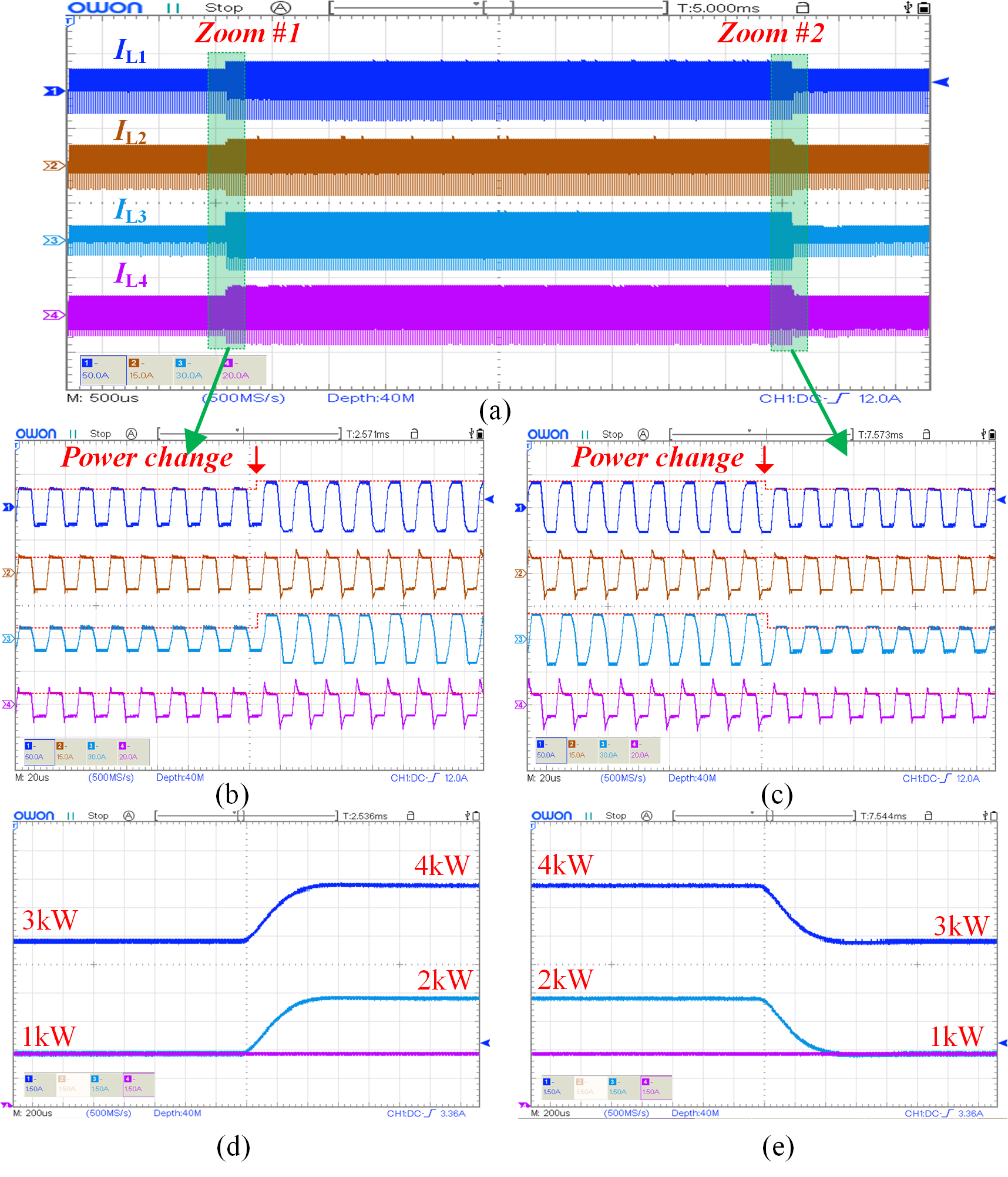
The framework was validated on a 50 kHz four-port multi-active-bridge converter. Online identification recovered four inductances with a tolerance of 0.05%, allowing the reconfigurable model to remain aligned with the hardware.
When embedded in MPC, the estimated high-frequency currents reached their new steady state in one switching cycle—about 20 μs—while the dc current settled in approximately 600 μs. Replacing sensor-aided sampling with a digital link also removed the roughly 2.5-cycle sampling delay; the communication path required only about 50 ns.
What makes the twin cognitive?
The term describes a twin that does more than replay a fixed simulation. It observes switching commands and measured terminal quantities, identifies the active circuit mode, updates uncertain physical parameters, and changes its internal model before predicting the next state. Each layer has a distinct role: mode awareness supplies speed, parameter learning supplies long-term accuracy, and the reconfigurable model keeps those updates physically meaningful.
This separation also limits the amount of data required. The twin does not learn converter dynamics from scratch; it learns the small set of quantities that causes the physical model to diverge from the hardware. As a result, the controller receives estimates that remain interpretable and can be checked against circuit constraints.
Why it matters
The digital twin is no longer only an observer. By combining online learning with event-driven physics, it becomes a real-time control component that can replace difficult measurements and adapt to hardware variation.
Published in IEEE Transactions on Industrial Electronics, vol. 72, no. 12, pp. 13310–13321, December 2025.